


Quick Answer:
Yes, but with a critical distinction. Most professional 3D skin analyzers support multi-terminal access—allowing a clinician to view scan data on an iPad or PC while the device is used for the next client—which solves the single-location throughput bottleneck. True cloud data management across multiple locations, however, requires a separate software layer. MEICET/ISEMECO has released a dedicated “Skin Cloud” (肌肤云) platform that aggregates data from all its 3D devices into a unified customer archive, supports cross-location case retrieval, and provides role-based access control. The ISEMECO D9 itself supports remote multi-device report access and real-time synchronization. For a single clinic, multi-terminal access may suffice; for a multi-location group, the cloud layer is the differentiator.
Key Takeaways
- ✔ Multi-terminal access ≠ cloud data management. A device that lets you view a report on an iPad solves the “device occupied” bottleneck, but does not centralize patient records across locations.
- ✔ The D9′s published workflow feature is “scan-consultation separation.” The scan is performed on the device, and the consultation happens on a separate tablet or computer, freeing the device for the next patient.
- ✔ MEICET’s Skin Cloud platform directly addresses multi-location fragmentation. It consolidates customer profiles, scan images, analysis reports, and treatment histories from multiple devices and locations into a single cloud-based archive.
- ✔ Role-based permission management is a cloud-layer feature, not a device-layer feature. The Skin Cloud includes configurable access controls so that staff at different locations or levels see only the data relevant to their role.
- ✔ Data ownership and export terms must be specified in the purchase agreement. Cloud architecture creates switching costs that are invisible at the point of sale.
A clinic group with three locations faces a problem that a single clinic does not: the patient who scanned at Location A and is now consulting at Location B needs their history available at Location B, not locked on the device at Location A. The ISEMECO 3D D9 is a clinical-grade device with published specifications including 0.2mm structured-light modeling, 42 million full-face pixels, and 0.1ml volume-difference precision. But the question of whether that device supports multi-location operations depends less on the device’s capture capability and more on the software architecture behind it.
1. The Device-Layer Feature: Multi-Terminal Access and “Scan-Consultation Separation”
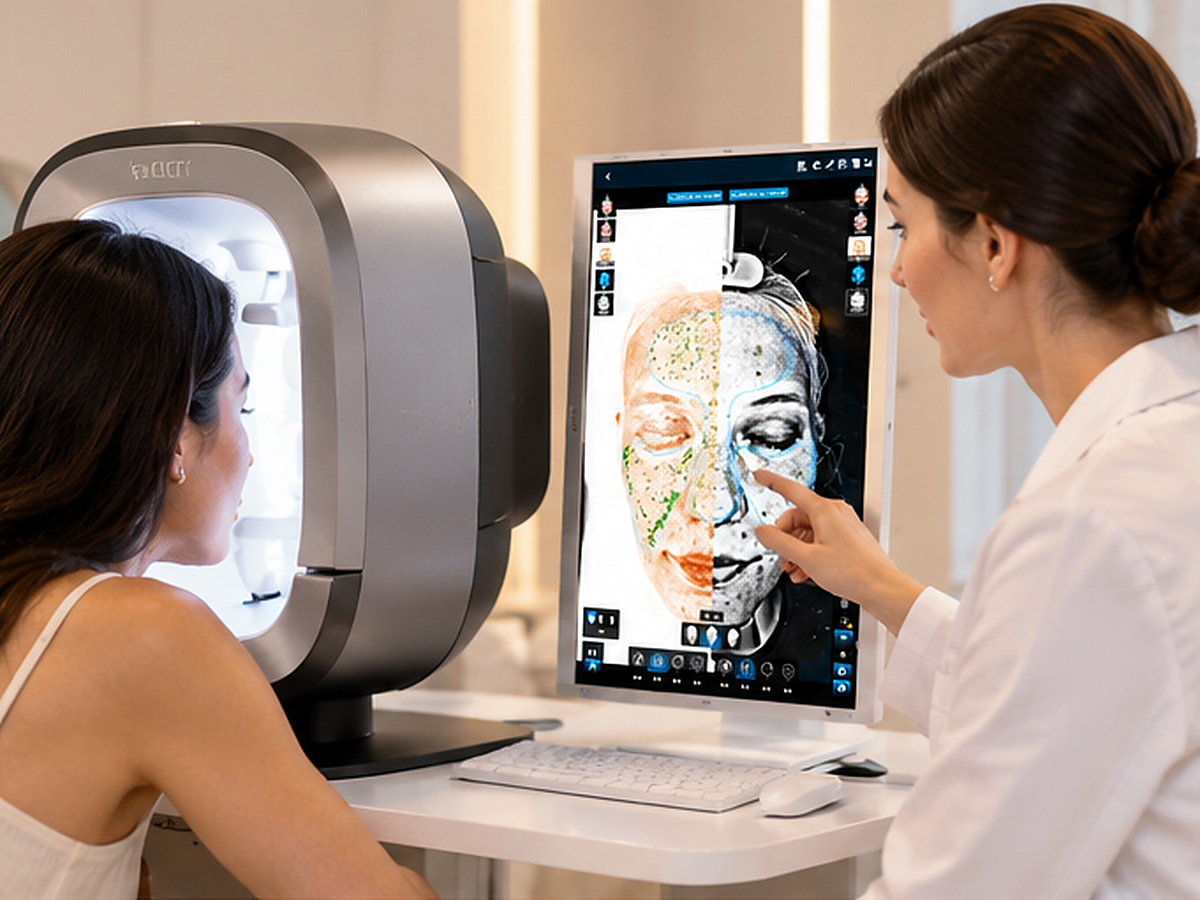
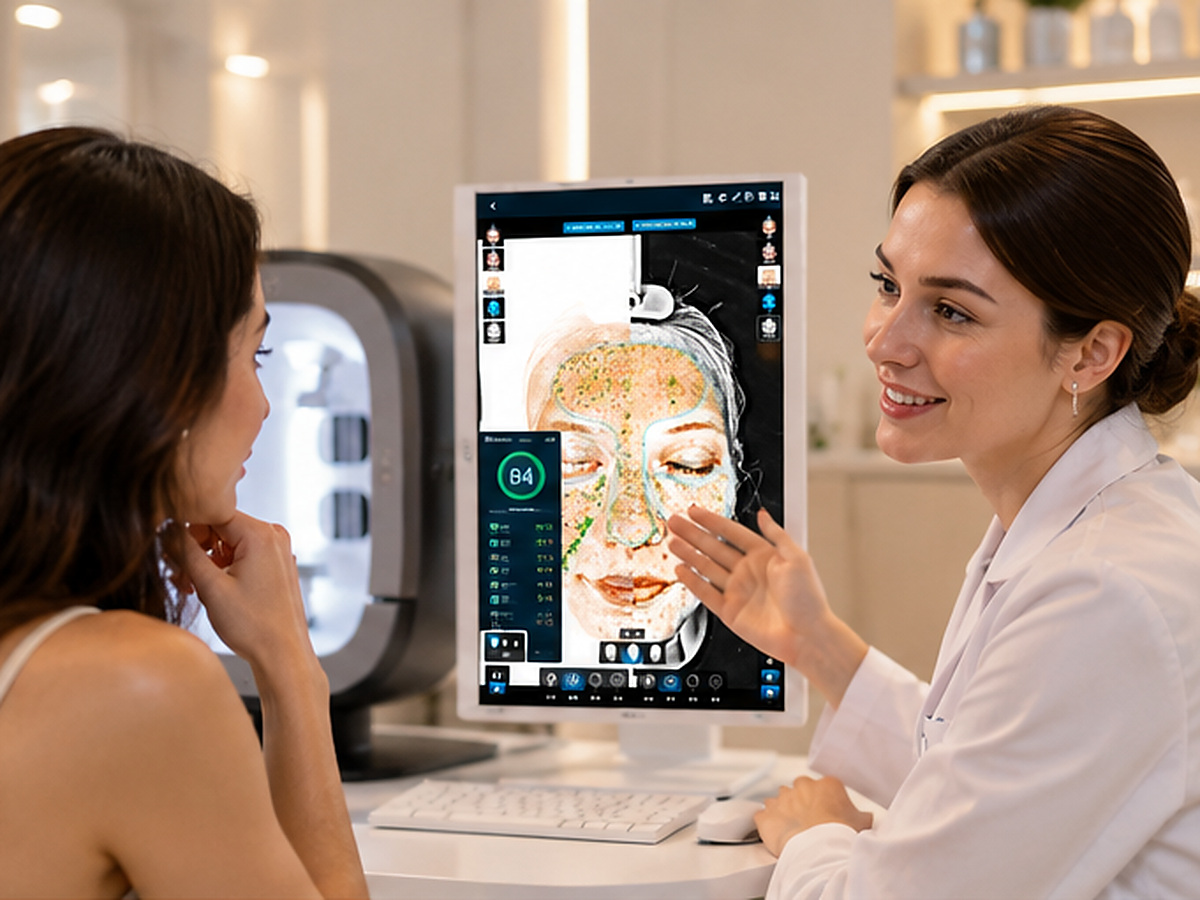
The D9′s multi-terminal access is a workflow optimization that addresses the most common bottleneck in skin analysis consultations. In a conventional setup, the patient sits at the device while the clinician reviews images on the same screen. The device is occupied for the entire consultation, and the next patient waits. ISEMECO describes the D9′s solution as “检诊分离” (scan-consultation separation): the patient completes the scan and leaves the device, while the clinician views the images and analysis on a separate iPad, computer, or tablet—landscape or portrait, local or remote—and the next patient begins scanning immediately.
MEICET reports that this workflow supports a daily capture capacity of 400+ scans at high-volume locations, because the device remains in continuous use for image capture rather than being idle during consultations. The multi-terminal system supports Android tablets, Android all-in-one machines, Apple iPad, Mac, and Windows PCs.
What this feature does not do is centralize data across locations. The multi-terminal access described in ISEMECO’s materials is a local or remote viewing capability, not a multi-site data warehouse. A clinician can view a report from outside the clinic, but the data architecture that enables this viewing is not the same as a cloud platform that aggregates and manages patient records across a multi-location enterprise.
| Feature Layer | What It Enables | What It Does Not Enable | Evidence |
|---|---|---|---|
| Multi-terminal access (D9) | Scan-consultation separation; remote viewing on iPad/PC; reduced device idle time | Cross-location patient record consolidation; centralized data governance | ISEMECO workflow documentation |
| Cloud platform (Skin Cloud) | Unified customer archive across devices/locations; case library; operational dashboards; role-based permissions | Device-level imaging and analysis | MEICET Skin Cloud release |
2. The Cloud Layer: MEICET’s “Skin Cloud” Platform for Multi-Location Operations
MEICET/ISEMECO launched a dedicated cloud platform in August 2026 specifically to address the data fragmentation problem that multi-device, multi-location institutions face. The “肌肤云” (Skin Cloud) system is described as a response to a specific operational failure: institutions buy multiple devices, but the data from each device is isolated, customer history is lost when staff turn over, and management cannot see cross-location performance.
The Skin Cloud platform’s published capabilities map directly to multi-location operational requirements:
- Unified customer archive: Data from all ISEMECO 3D devices is aggregated into a single customer profile containing personal information, high-definition skin images, analysis reports, treatment plans, customer tags, and aesthetic design history. The profile is retrievable from any location.
- Cross-location case library: Success cases can be authorized, tagged, and retrieved by category, time, or keyword across the institution’s entire footprint. Before/after comparisons are accessible without searching through chat records or local folders.
- Operational data center: Dashboards show customer demographics, detection volume, symptom rankings, and device utilization across all connected devices. Management can see which location has the highest sensitive-skin client volume, or which device is underutilized, without compiling reports manually.
- Role-based access control: Permissions are configurable by role, so that staff at different locations or levels do not see all customer data by default. The Skin Cloud’s permission management module is positioned as a privacy and data-security feature for larger organizations.
3. What to Verify Before Assuming Multi-Location Support
The gap between “remote viewing” and “cloud data management” is where procurement assumptions fail. A supplier that demonstrates a report viewed on an iPad has demonstrated remote access. That is not the same as a cloud platform that stores, organizes, and governs patient data across locations.
Buyers evaluating multi-location support should verify the following, in writing:
- Data storage architecture: Where is patient data stored by default? On the device, on a local server, or in the manufacturer’s cloud?
- Cross-location retrieval latency: If a patient scans at Location A and consults at Location B an hour later, how quickly does the Location B clinician see the data?
- Data export and portability: If the clinic group ends its relationship with MEICET, can it export patient data in a usable format?
- Permission granularity: Whether a location manager can see only their location’s data, or all locations?
- Regulatory compliance: Documentation for GDPR, HIPAA, or local equivalents.
4. Multi-Location Deployment Scenarios
| Operational Scenario | Primary Need | Minimum Software | Recommended Architecture |
|---|---|---|---|
| Single clinic, multiple devices | Device utilization; throughput | Multi-terminal access (D9 native) | Local network viewing |
| Two-location clinic group | Shared patient history | Cloud archive | Skin Cloud or equivalent |
| Regional chain (5+ locations) | Standardization; governance | Cloud platform with RBAC | Skin Cloud with governance terms |
The decision point between scenarios is the need for cross-location patient history. A clinic with one location and two devices does not need a cloud platform; the D9′s multi-terminal access is sufficient. A two-location group that shares patients needs the cloud layer. A regional chain needs the cloud layer plus the governance features—permissions, analytics, and export controls—that determine whether the platform is a data asset or a data lock-in.
Q1: Does the ISEMECO D9 support cloud data storage without the Skin Cloud platform?
The D9′s published features include remote multi-device report access and local or remote data synchronization. The Skin Cloud platform is a separate software layer that aggregates data across devices and locations. The D9′s native remote access is a viewing and synchronization capability, not a multi-location cloud archive.
Q2: Can two locations access the same patient’s scan data in real time?
The Skin Cloud is described as consolidating data from all ISEMECO 3D devices into a unified customer archive accessible from any location. Real-time synchronization is a technical specification that should be tested during the sales process, not assumed from the platform’s description.
Q3: What happens to patient data if I stop using the Skin Cloud?
Data portability is a contractual matter, not a technical default. The purchase agreement should include a data export clause specifying the format (e.g., DICOM, PDF, JPEG), the export process, and the time frame for data retrieval after termination.
Q4: Is the Skin Cloud compliant with GDPR or HIPAA?
MEICET’s materials do not disclose hosting location or compliance certifications. A clinic subject to GDPR or HIPAA should request a written data processing agreement and security documentation during the procurement process.
Q5: Does the D9′s multi-terminal access work across different locations without the cloud platform?
The D9 supports local or remote viewing. “Remote” may mean outside the clinic but on the same network. It does not necessarily mean Location A can be accessed by Location B without a centralized cloud service. This should be clarified in writing.
Q6: Can I manage user permissions by location on the Skin Cloud?
The Skin Cloud includes a role management module that supports configurable functional permissions. The actual granularity must be tested against the clinic group’s organizational requirements during the sales process.
Q7: Is the cloud platform required for multi-location operations, or can I use a third-party solution?
This depends on the D9′s data output format. If the data is locked in a proprietary format, the Skin Cloud is the only path. If it exports standard formats (JPEG, PDF, DICOM), a third-party PACS or cloud solution might be feasible.
Post time: Nov-04-2026


