


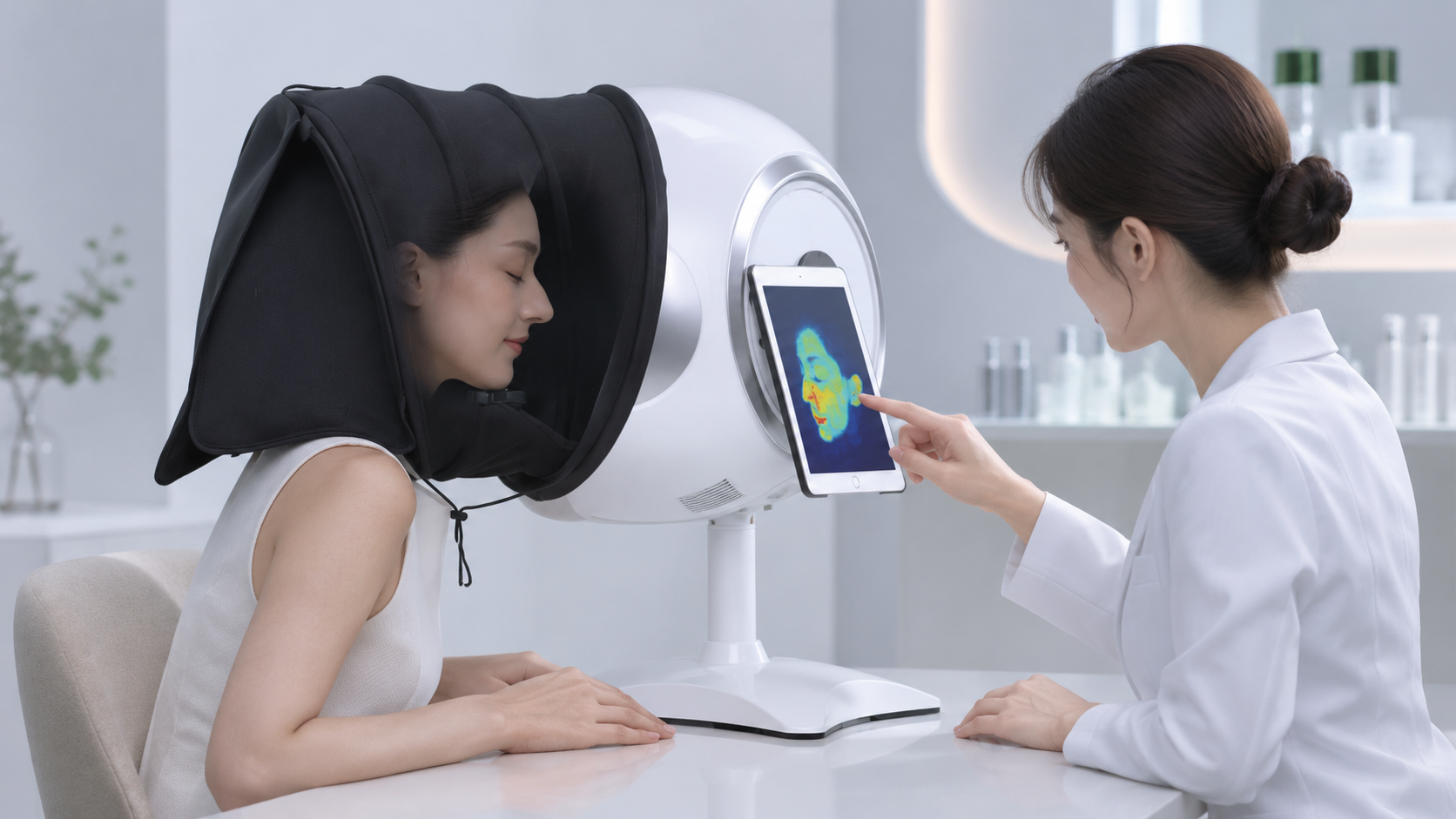
Most professional face analysis machine manufacturers, including MEICET (the parent brand of ISEMECO), explicitly support sample orders before bulk commitments. The standard sample tier covers 1–2 units at 10–20% off MSRP, positioned specifically for initial evaluation and client demonstrations. A sample unit is a purchased device, not a free trial or loaner—but it carries the same hardware and software as a bulk-order unit, allowing you to test imaging quality, workflow integration, and AI analysis relevance in your own clinic environment before committing capital to inventory. For the ISEMECO S7 specifically, a sample order lets you verify the 24-megapixel imaging, multi-spectral capture modes, and comparison workflow against your actual consultation mix.
Key Takeaways
- ✓ Sample orders of 1–2 units are a standard wholesale tier, discounted 10–20% below MSRP—distinct from the 30–40% discount available at 5–20 unit stocking volumes.
- ✓ The sample unit is a purchase, not a trial: you own the device, and it carries the same specifications as bulk-order units.
- ✓ Sample orders below a supplier’s published MOQ are routinely negotiable to validate partnerships before scaling.
- ✓ The primary purpose of a sample unit is de-risking integration: testing whether the device’s workflow, report format, and scan time fit your clinic’s operational reality.
- ✓ For the ISEMECO S7, the sample evaluation should verify 20MP full-face resolution, four spectral modes (RGB, CPL, PPL, UV), and the nine-image simultaneous display workflow before any volume commitment.
Why Manufacturers Offer Sample Orders
Sample orders exist because aesthetic imaging equipment carries integration risk that specifications alone cannot reveal. A face analysis machine is not a standalone product—it generates patient data, produces consultation reports, and feeds into treatment planning and follow-up workflows. A clinic that orders five units without first testing one in its own environment risks discovering that the software’s report format does not match its branding, that the scan time disrupts patient flow, or that the AI analysis dimensions do not align with the treatments the clinic actually sells.
MEICET’s wholesale guidance acknowledges this directly. The Sample/Demo tier is described as serving “initial evaluation, customer demos,” distinguishing it from the Standard Stocking tier intended for distributors establishing market presence. The pricing structure creates a deliberate gap: a buyer who purchases 1–2 units pays 10–20% below MSRP, while a buyer who commits to 5–20 units receives 30–40% below MSRP. This gap reflects the supplier’s reduced per-unit sales and support cost at volume, not a quality difference between sample and bulk units.
The sample pathway also serves a negotiation function. Published minimum order quantities are starting positions, and MEICET’s own guidance states that sample orders below the stated MOQ are commonly accepted to validate a partnership before scaling. A buyer who demonstrates serious intent—through a credible business plan, a clear territory strategy, or a commitment to repeat orders—has more leverage than a one-time purchaser.
What the Sample Unit Actually Is—and Is Not
The sample unit is a purchased device at a discounted price, not a loaner or a free trial. MEICET’s pricing documentation lists the Sample/Demo tier as 1–2 units at 10–20% off MSRP. This is a commercial transaction, and the buyer owns the unit upon delivery.
The sample unit carries the same hardware and software as a bulk-order unit. For the ISEMECO S7, that means the 24-megapixel ultra-micro optical lens, the four spectral capture modes (RGB, parallel-polarized, cross-polarized, UV), the nine-image simultaneous display, and the comparison workflow (mirror, two-image, multi-image, and 3D comparison) are all present in the sample device. The S7’s published specifications—including its 5–7 year skin aging simulation, multi-terminal access capability, and customizable report branding—are standard capabilities, not tier-dependent add-ons.
| Evaluation Criterion | ISEMECO S7 Specification to Verify | Why It Matters |
|---|---|---|
| Sensor resolution | 24MP ultra-micro optical lens | Verify actual output sharpness at maximum magnification; pore-level detail should be visible |
| Spectral modes | RGB, CPL, PPL, UV (four modes) | Confirm UV capture reveals subsurface pigment and porphyrin fluorescence |
| Comparison workflow | Mirror, 2-image, multi-image, 3D comparison | Test whether side-by-side and longitudinal comparison match your consultation flow |
| Report customization | Logo, QR code, OEM watermark options | Verify whether report branding aligns with your clinic identity |
| Multi-terminal access | LAN multi-port support, SaaS/CRM interface | Confirm whether scan records are accessible across consultation rooms |
What the sample unit is not: a free trial, a returnable loaner, or a device with reduced capabilities. MEICET’s documentation does not describe a return policy for sample units, so return terms and warranty coverage should be confirmed in writing before purchase. The sample tier is designed to let you evaluate the device’s fit for your practice before committing to stocking volumes—not to provide a no-risk trial period.
What to Test During the Sample Evaluation Period
A structured evaluation protocol converts the sample period from a passive inspection into a de-risking exercise. The following steps should be executed within the first two weeks of receiving the unit, while the vendor’s technical support is most engaged.
Use a client or staff member with visible pigmentation, vascular redness, or texture concerns. Compare the S7’s UV and cross-polarized outputs against your own visual assessment under standard lighting. The spectral views should reveal subsurface structures not visible in the standard RGB image.
Request deviation data between captures. A well-standardized system with fixed positioning should produce minimal variation in quantitative scores. High variation indicates that diagnostic noise will obscure real treatment effects in longitudinal tracking.
From client positioning to report generation, measure how long a complete scan-and-review session takes. If the process exceeds the time your consultation model allows, the device’s workflow is misaligned with your operations—regardless of its imaging quality.
Simulate a second visit by accessing the first capture and generating a side-by-side comparison. The S7’s multi-image comparison modes should make date-stamped comparison intuitive, not require a technician to navigate menus.
Time how long it takes someone unfamiliar with the device to identify the primary concern and understand the recommended next step. If clarification is required, the report design is insufficient for consultative use.
Measure response time and quality. The sample period is your only opportunity to evaluate after-sales responsiveness before committing to multiple units.
For the S7’s floor-standing configuration, on-site service capability matters. Confirm warranty duration for the main unit versus accessories, calibration frequency and cost, and whether authorized service partners exist in your region.
Sample-to-Bulk Economics: What the Discount Structure Reveals
The pricing gap between sample and bulk tiers is a negotiating signal, not a penalty. MEICET’s wholesale structure positions the sample tier at 10–20% off MSRP, the standard stocking tier at 30–40% off, and volume commitments at 40–50% off. The implication for a buyer evaluating the ISEMECO S7 is that the sample purchase price is not the price you will pay for a stocking order—and the supplier knows this.
| Tier | Order Quantity | Typical Discount | Best For |
|---|---|---|---|
| Sample / Demo | 1–2 units | 10–20% off MSRP | Initial evaluation, client demos |
| Standard Stocking | 5–20 units | 30–40% off MSRP | Distributors establishing market presence |
| Volume Commitment | 20–50+ units annually | 40–50% off MSRP | Established distributors with proven demand |
The practical negotiation sequence is straightforward: purchase one unit at the sample tier, evaluate it rigorously against your consultation mix, and then negotiate the stocking order terms using the evaluation results as leverage. A buyer who can document specific integration challenges—and propose solutions—has more credibility than one who simply asks for a discount.
For buyers concerned about sample unit cost, the question to ask is not “can I get a free trial” but “what does the sample discount offset?” The 10–20% sample discount effectively reduces the cost of the evaluation unit by an amount that may cover initial training or a portion of first-year calibration. The sample unit becomes a demonstration device for your showroom or a backup unit once the bulk order arrives—it is not wasted capital.
Frequently Asked Questions
The sample unit is a purchase at 10–20% off MSRP for 1–2 units. It is not a free trial or loaner program. The discount reflects the supplier’s reduced sales cost for a single-unit transaction, not a quality difference between sample and bulk units.
MEICET’s published documentation does not describe a return policy for sample units. Return terms and warranty coverage should be confirmed in writing before placing the order. The sample tier is designed for evaluation, but the transaction is a purchase, not a trial.
Yes. The sample unit carries the same hardware and software as a bulk-order unit. For the ISEMECO S7, this includes the 24MP imaging system, four spectral modes, nine-image display, comparison workflows, and report customization options.
Shipping timelines for sample orders are typically shorter than bulk orders because no production scheduling is involved—the unit ships from existing inventory. MEICET’s guidance distinguishes between production lead time (not applicable to sample units), transit time, and customs clearance time. For international orders, customs documentation accuracy is the primary variable affecting delivery speed.
Discounts beyond the standard sample tier are unlikely for a single unit, but the sample purchase can be structured as the first step in a larger negotiation. A buyer who signals serious intent—a clear territory plan, a credible volume projection, or a commitment to a stocking order contingent on evaluation results—may secure favorable terms on the subsequent bulk order rather than on the sample itself.
Logo-only customization on an existing certified platform can start at 1–10 units, which aligns with the sample tier. The ISEMECO S7 supports logo, QR code, and OEM watermark customization as standard software features. However, any physical housing modification would trigger retesting and push the order into a higher MOQ tier.
The sample evaluation protocol is similar across product tiers—the difference lies in what you are testing. A lower-priced portable scanner may suffice for basic skin hydration and oiliness assessment, but the S7’s clinical-grade specifications (24MP resolution, four spectral modes, floor-standing build) require evaluation against medical aesthetics and dermatology-adjacent consultation scenarios. The sample unit’s purpose is to confirm that the device’s capabilities match the consultations your practice actually delivers, not to compare against devices designed for different use cases.
Post time: Nov-19-2026


