


? Quick Answer
A professional skin detector machine like the MEICET 3D MD300 requires very few true consumables because its core imaging system is designed for repeatable, non-invasive capture. The primary wear items are protective contact surfaces and calibration references that degrade with normal use, not the optical or electronic components themselves. Most routine expenditure goes toward cleaning supplies, disposable skin-prep materials, and periodic recalibration services rather than replacement parts. Buyers should distinguish between genuine consumables (items designed to be used up) and wearing parts (components with finite service life), because conflating the two leads to inflated operating-cost estimates and unnecessary stocking.
Key Takeaways
- ✔ True consumables are minimal: professional 3D skin analyzers rely on reusable optics, not disposable sensors or cartridges.
- ✔ Wearing parts concentrate on patient-contact surfaces and calibration references, not the camera or LED array.
- ✔ Cleaning and disinfection supplies represent the largest recurring operational expense for most clinics.
- ✔ Software and AI analysis require no physical consumables but may involve subscription or update costs.
- ✔ Preventive maintenance extends the life of high-value components and reduces unplanned downtime.
Why “Consumables” Is a Misleading Term for Skin Analyzers
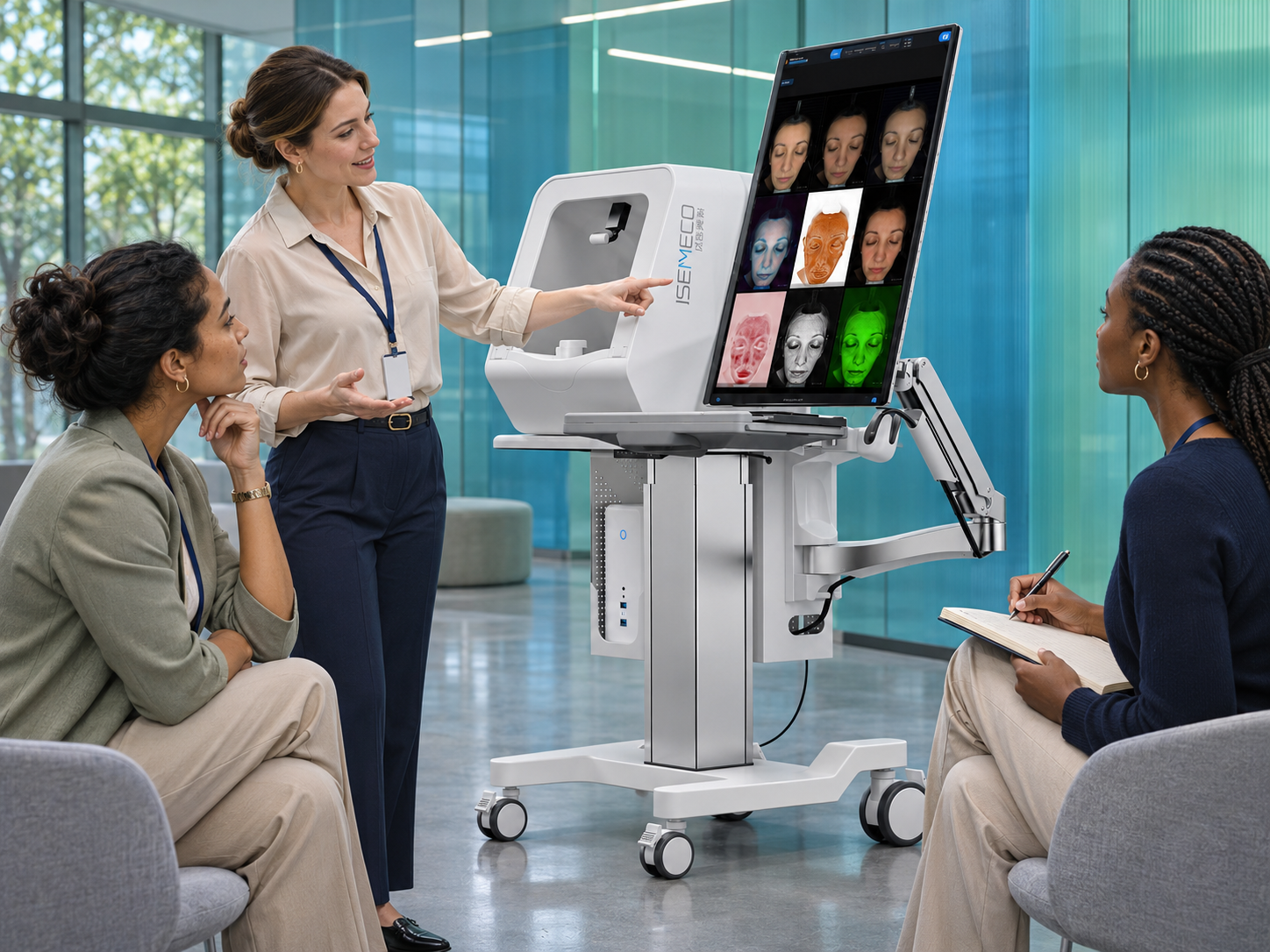
A skin detector machine is fundamentally different from devices that consume reagents, films, or probes. The MEICET 3D MD300, for example, captures facial images using a 32-megapixel imaging system with solid-state LED illumination across RGB, cross-polarized, UV, and parallel-polarized light spectra. Nothing in this optical path is designed to be discarded after each use. The device functions more like a precision camera than a diagnostic strip reader.
This distinction matters for procurement planning. A clinic budgeting for “consumables” based on analogies to blood analyzers or ultrasound gel will overestimate recurring costs and may overlook the items that genuinely require periodic replacement. The real operational question is not “what gets used up” but “what degrades with handling and time.”
The Actual Wear Items: Patient-Contact and Positioning Surfaces
The components most likely to require replacement are those that touch the patient or guide patient positioning. The MD300 uses forehead and chin supports to stabilize head placement during image capture. These contact surfaces accumulate skin oils, cosmetic residue, and cleaning agents over hundreds of capture sessions. While the supports themselves are durable, the soft contact pads or covers—if present in a given configuration—are the first items to show wear.
Equally important are the calibration references used to maintain color and exposure consistency. Multi-spectral imaging depends on stable illumination and sensor response. Manufacturers typically provide calibration targets or reference cards that should be checked periodically and replaced if they show discoloration, scratching, or physical deformation. A compromised calibration reference introduces systematic error into every subsequent analysis, making this a high-consequence wear item despite its low cost.
Cleaning and Disinfection: The Largest Recurring Expense
For most clinics, the dominant recurring cost is not a replacement part but cleaning and disinfection supplies. Patient-contact surfaces must be cleaned between clients to prevent cross-contamination. The appropriate agents depend on the surface material—ABC, PC, silicone, and metal are listed in the MD300 specification—and on the manufacturer’s compatibility guidance.
Alcohol-based wipes are commonly used for hard surfaces, but aggressive solvents can cloud polycarbonate windows or degrade silicone pads. Clinics should establish a written cleaning protocol that specifies the agent, contact time, and surfaces to be treated, and should stock compatible wipes or sprays in sufficient quantity to support daily operation.
Software, Calibration, and Algorithm Updates
The MD300’s analytical capability depends on its AI algorithms and cloud connectivity. These systems may require periodic calibration verification or software updates to maintain accuracy. While no physical consumable is involved, clinics should plan for:
- Annual or biannual calibration verification if the manufacturer recommends it
- Software subscription or support fees, if applicable to the purchased license
- Network and data storage costs associated with cloud-based analysis records
What Does Not Require Routine Replacement
- LED illumination modules: solid-state LEDs have long service life and are not user-replaceable consumables
- Imaging sensor and optics: sealed within the device; replacement is a service event, not routine maintenance
- Structural frame and positioning mechanism: the floor-standing column and adjustment system are durable mechanical assemblies
Comparison: Consumables vs. Wearing Parts vs. Service Items
| Category | Examples for a Skin Analyzer | Replacement Frequency | Who Typically Manages |
|---|---|---|---|
| True consumables | Cleaning wipes, disinfectant solution, disposable skin-prep pads | Daily to weekly | Clinic staff |
| Wearing parts | Contact pads/covers, calibration reference cards | Monthly to annually | Clinic staff + supplier |
| Service items | LED module, imaging sensor, structural repair | On failure | Authorized provider |
| Software/calibration | Algorithm updates, calibration verification | Annually/per license | Clinic + supplier |
L Practical Procurement Checklist
- Which patient-contact surfaces are designed to be replaced, and what is the recommended interval?
- Does the device include calibration reference materials, and how often should they be checked or replaced?
- What cleaning agents are approved for the device’s housing and contact surfaces?
- Are software updates included, and for how long?
- What is the recommended calibration verification schedule, and is it performed on-site or by return-to-factory service?
- Are there any components with a defined service life that should be budgeted for replacement?
FAQ
Does a 3D skin analyzer need disposable probe covers?
No. Professional 3D skin analyzers like the MEICET 3D MD300 capture images from a distance using optical imaging, not contact probes. There is no need for disposable covers on the imaging path.
How often should calibration reference cards be replaced?
Replacement depends on handling and storage conditions. Calibration references should be inspected monthly. A common practice is annual replacement to eliminate drift as a source of error.
Can I use alcohol wipes on the device?
Alcohol wipes are generally acceptable for metal, but they may degrade polycarbonate or silicone components. Always confirm the approved cleaning agents with the manufacturer.
Are the LED lights user-replaceable?
No. The solid-state LED illumination system is a sealed assembly. LED failure is rare, but if it occurs, the device requires service by an authorized technician.
What happens if I skip calibration verification?
Skipping calibration verification risks silent accuracy drift. For clinics that document treatment progress over months, calibration integrity is essential to the clinical value of the records.
Do software updates cost extra?
This depends on the purchase agreement. Clarify the terms before purchase so that the operating budget reflects reality.
Is it cheaper to buy third-party cleaning supplies?
Third-party supplies may be cost-effective if chemically compatible. However, using an incompatible agent can cause permanent damage to housings or optical windows.
Post time: Nov-25-2026


