


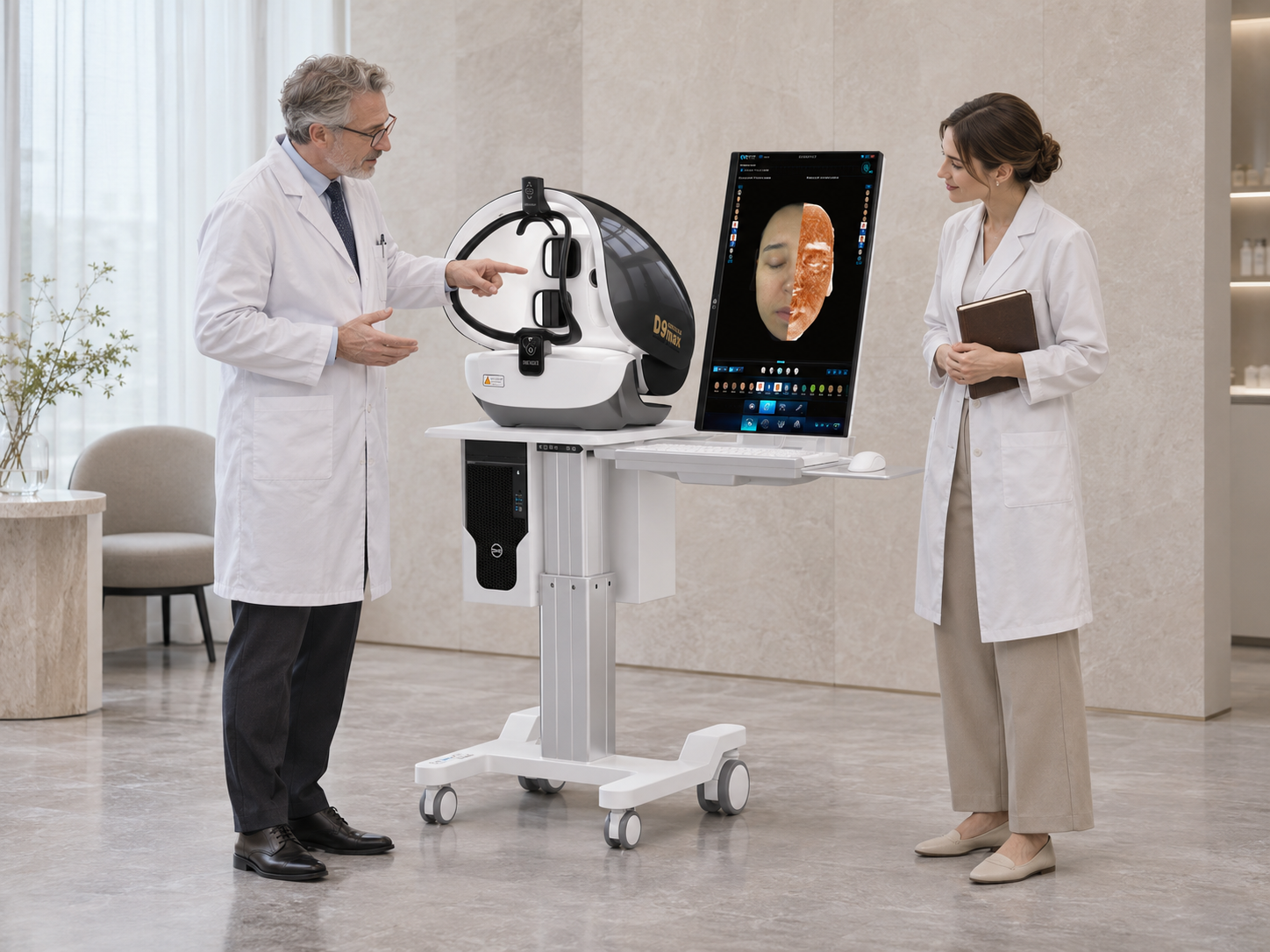
A professional 3D skin detector machine like the ISEMECO D9MAX requires a consultation room large enough to accommodate the device footprint while maintaining at least 60–80 cm of clearance in front of the capture position for client seating and staff movement. The power requirement is modest—a standard wall outlet supplying 24V DC through the included adapter, with maximum power draw well within a normal 10A or 16A circuit. Network connectivity is not mandatory for core scanning and analysis functions, but a stable Wi-Fi or Ethernet connection is recommended if the clinic intends to use multi-terminal report viewing, remote consultation access, or client data backup across devices.
- ✔ Room size is determined by device footprint plus clearance, not by a fixed minimum; a dedicated consultation room of roughly 2m × 2.5m provides comfortable working space for the device, the client, and the staff member.
- ✔ The power supply uses a standard wall outlet and a dedicated adapter; no special electrical wiring, three-phase power, or high-amperage circuit is required for normal operation.
- ✔ Network connectivity is optional for standalone scanning but beneficial for multi-terminal workflows; the device can capture and analyze images without an active internet connection.
- ✔ Ambient lighting control matters more than room dimensions for image consistency; the ability to dim overhead lights during UV and polarized captures improves capture quality.
- ✔ Clinics planning to integrate the device into an existing consultation room should verify door width and corridor clearance before delivery, as the assembled unit is tall and requires careful handling during installation.
Room Size and Spatial Requirements: What the Device Actually Needs
The ISEMECO D9MAX has a published footprint of approximately 1.09m in length, 0.97m in width, and 1.5m in height, but the usable room space required is larger than these dimensions because the device must be accessed from the front for client positioning and from the side or rear for staff operation. The device dimensions specify the physical envelope of the equipment itself; they do not account for the client chair, the staff standing area, or the clearance needed to open doors and move around the device .
The practical minimum for a dedicated skin analysis room is approximately 2 meters by 2.5 meters. This allows the device to be positioned against one wall, a client chair to be placed in front of the capture position with enough distance for the camera to frame the face, and a staff member to stand beside the client to assist with positioning and operate the controls. A room smaller than this creates a cramped experience for the client and makes it difficult for staff to move between the device and the client without disrupting the capture setup.
For clinics evaluating how the device integrates into an existing consultation room layout, the ISEMECO 3D D9MAX product page provides a reference for the system’s physical configuration and installation considerations.
Power Supply: Standard Outlet, No Special Wiring
The ISEMECO D9MAX operates on a 24V DC input supplied through an external power adapter, with a maximum power draw that is well within the capacity of a standard wall outlet. The published input requirement is 24V at 5.0A, and the rated power is 15W in standby mode and 50W at maximum . This is comparable to the power consumption of a desktop computer or a small appliance. No three-phase power, no dedicated circuit, and no high-amperage outlet is required.
Network and Connectivity: Optional for Scanning, Useful for Workflow
The ISEMECO D9MAX does not require a network connection to perform its core function of image capture and AI analysis. The device can scan a client, generate the analysis report, and display the results without being connected to the internet or a local network. This is an important consideration for clinics with unreliable connectivity or concerns about data privacy during the scanning process.
Network connectivity becomes relevant when the clinic wants to use the device’s multi-terminal capabilities. The system supports remote report viewing on iPads and computers, allowing the consultation to take place away from the capture station . This workflow—capture at the device, review the report on a separate screen—requires the device and the review terminals to be on the same local network, or to have access to a shared cloud or server-based system. Without network connectivity, the report is available only on the device itself, which limits the workflow flexibility that makes high-throughput consultation possible.
Environmental Conditions and Room Preparation
Beyond size, power, and network, the consultation room’s environmental conditions affect the device’s performance and longevity. The published operating temperature range is 0°C to 40°C, and the storage temperature range is -10°C to 40°C . These ranges are broad enough to accommodate normal clinic environments, but extreme conditions should be avoided.
Ambient lighting control is the most important environmental factor for image quality. The device captures images under its own controlled illumination (RGB, cross-polarized, parallel-polarized, and UV), but strong ambient light—particularly direct sunlight or bright overhead lighting that shines onto the client’s face—can interfere with the capture by introducing uncontrolled reflections and reducing the contrast of the device’s illumination.
Frequently Asked Questions
Q: What is the minimum room size for a skin detector machine?
A: A dedicated consultation room of approximately 2m × 2.5m provides comfortable working space. The device footprint is roughly 1.09m × 0.97m, and the additional space accommodates the client chair, staff positioning area, and movement clearance.
Q: Does the machine need a special power outlet?
A: No. The device uses a standard wall outlet through its included power adapter, with a maximum power draw of 50W. No three-phase power, dedicated circuit, or high-amperage outlet is required. A dedicated outlet or surge protector is recommended to protect the imaging electronics.
Q: Can the machine work without internet connection?
A: Yes. Core scanning and analysis functions operate without a network connection. Internet or local network connectivity is only needed for multi-terminal report viewing, remote consultation access, or cloud-based data storage.
Q: Do I need to dim the room lights during a scan?
A: It is recommended. The device has its own controlled illumination, but strong ambient light—especially direct sunlight or bright overhead lights—can interfere with capture quality. A room with adjustable lighting allows for consistent, repeatable images.
Q: How much clearance is needed in front of the device?
A: At least 60–80 cm between the device front and the back of the client chair. This allows the client to sit comfortably at the capture position and gives the staff member room to adjust positioning supports and operate the device.
Q: Can the device be moved between rooms?
A: The device is floor-standing and substantial (instrument weight approximately 16.7 kg, total shipping weight nearly 30 kg). Moving it between rooms regularly is not recommended for routine operation.
Post time: Nov-24-2026


