


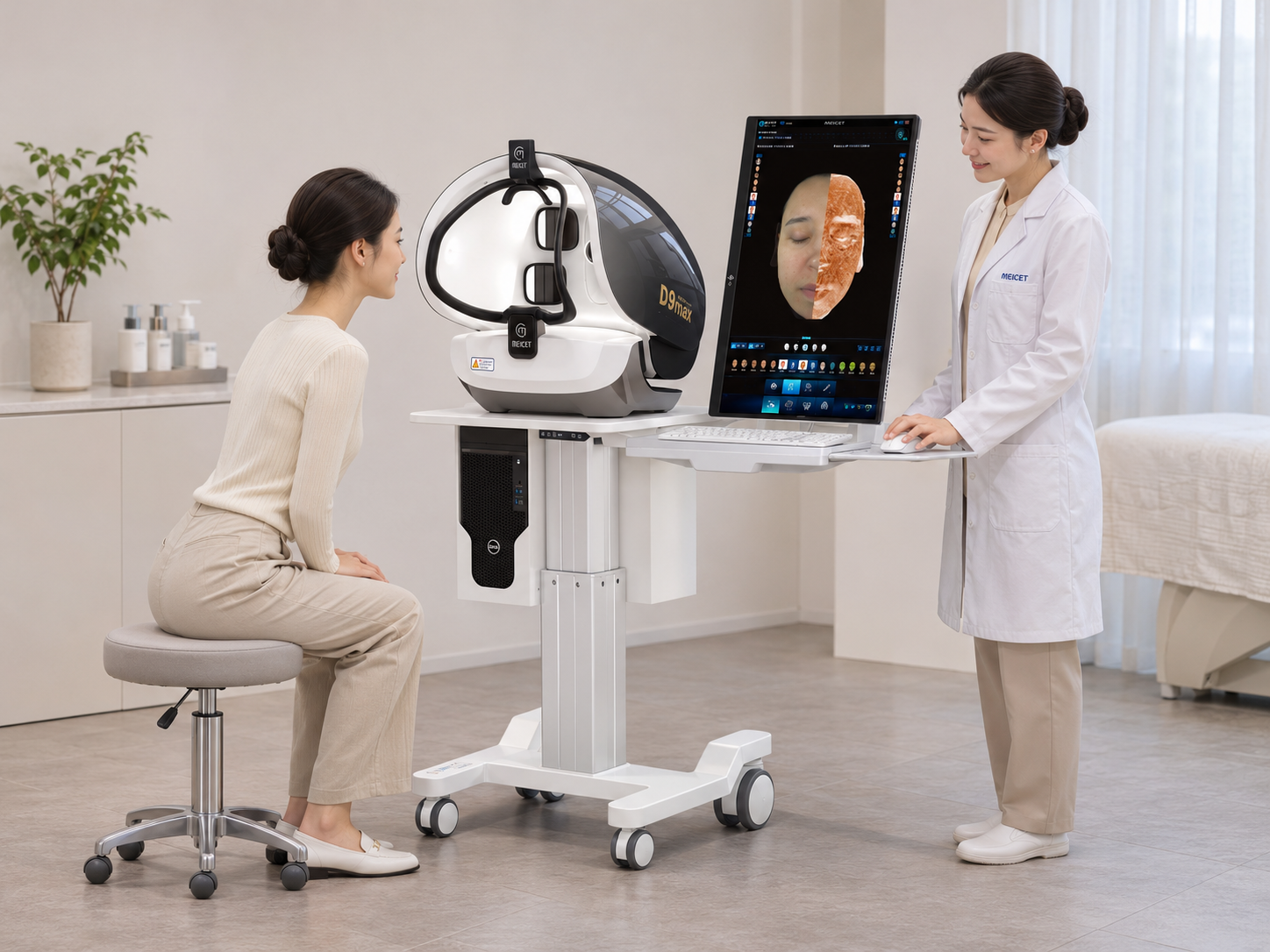
Quick Answer: The UV and blue light used in professional skin detector machines are generally safe for eyes under normal operating conditions, provided the device is used as intended and clients keep their eyes closed during the brief capture window. The UV source in these devices is a low-intensity, narrowband emission used for fluorescence excitation, not the broadband, high-irradiance UV found in tanning beds or industrial curing lamps that regulators warn about. The blue light component is a byproduct of the LED illumination and imaging system, and the exposure duration is measured in seconds rather than the prolonged viewing that eye-safety research identifies as the threshold for concern. The practical risk is not the light itself but the absence of a clear instruction to close the eyes during UV capture.
Key Takeaways:
- • Skin detector UV is low-intensity and narrowband (typically around 365 nm), fundamentally different from the broadband UV in tanning devices that the FDA and WHO link to eye damage.
- • The exposure duration during a scan is brief—seconds, not minutes—which places it well below the acute exposure thresholds identified in eye-safety research.
- • Blue light hazard to the retina requires staring directly at a high-intensity source for an extended period; a diffuse LED illumination array during a facial scan does not meet that condition.
- • The most effective safety measure is procedural: instruct clients to close their eyes during the UV capture phase, which eliminates direct ocular exposure entirely.
- • Clinic owners should request the device’s photobiological safety classification (IEC 62471) to verify that the manufacturer has tested the product against recognized optical radiation safety standards.
What Kind of UV and Blue Light Are We Actually Talking About?
The UV and blue light in a skin detector machine are categorically different from the radiation sources that regulators and researchers warn about. The confusion arises because “UV” and “blue light” are broad terms that encompass everything from a harmless fluorescence excitation source to industrial curing lamps and tanning beds. The distinction matters for a realistic safety assessment.
The UV source in a professional skin analyzer is typically a narrowband emission centered around 365 nm, which falls in the UVA range. This wavelength is chosen specifically because it excites melanin and porphyrins to produce visible fluorescence without the DNA-damaging potency of shorter-wavelength UVB or UVC. The intensity is low—sufficient to generate a fluorescence image through a sensitive camera sensor, but not the high-irradiance output of a tanning bed or a UV curing system. The manufacturer’s own technical documentation describes the light as “harmless and low in UV content” and emphasizes that the purpose is fluorescence excitation, not irradiation.
| Parameter | Skin Detector UV | Tanning Bed UV | Clinical Relevance |
|---|---|---|---|
| Wavelength | Narrowband ~365 nm (UVA) | Broadband 200–400 nm | Skin detector avoids UVB/UVC |
| Intensity | Low, camera-optimized | High, erythema-inducing | Orders of magnitude difference |
| Exposure duration | Seconds per scan | Minutes per session | Acute risk scales with duration |
| Primary hazard | None at intended use | Skin cancer, eye damage | Not comparable exposure scenarios |
The Eye-Safety Threshold: Why Duration and Intensity Matter More Than Wavelength
Eye damage from optical radiation is a function of intensity, duration, and wavelength—not wavelength alone. A low-intensity source at a given wavelength can be safe while a high-intensity source at the same wavelength is hazardous. The exposure conditions during a skin scan fall on the safe side of that equation for both UV and blue light.
For UV, the acute effects that the WHO describes—photokeratitis and photoconjunctivitis—are associated with exposure to solar UV at high altitudes or over reflective surfaces like snow, where irradiance is intense and exposure can last for hours. The chronic effects, including pterygium and cataract, are linked to cumulative lifetime exposure to solar UV. A skin scan exposes the closed or open eye to a low-intensity UV source for a few seconds at most.
The Practical Safety Protocol: What Clinics Should Actually Do
Standard Operating Procedure
The most effective eye-safety measure for a skin detector machine is not a technical specification but a procedural instruction: have the client close their eyes during the UV capture phase. This single step eliminates direct ocular exposure to the UV source without affecting the quality of the facial image.
Verifying Manufacturer Compliance: What to Ask Before You Buy
The manufacturer’s photobiological safety testing is the most reliable assurance that a device has been designed and evaluated against recognized optical radiation standards. Buyers should request documentation rather than relying on general claims that the light is “safe.”
IEC 62471 is the international standard for photobiological safety of lamps and lamp systems. It classifies products into risk groups (Exempt, Group 1, Group 2, Group 3) based on their potential to cause photobiological hazards. A skin detector machine intended for close-range facial imaging should be classified as Exempt or Group 1 (low risk) under this standard.
For clinics evaluating a specific system’s documentation and safety features, the ISEMECO 3D D9MAX product page provides a reference for the device’s construction and intended use in professional consultation settings.
Frequently Asked Questions
Q: Do clients need to wear protective goggles during a skin scan?
A: No. Protective goggles are not standard for skin analysis because the exposure is brief and low-intensity. The appropriate precaution is to have the client close their eyes during the UV capture phase.
Q: Is the UV light in a skin analyzer the same as a tanning bed?
A: No. Tanning beds emit broadband UV at high intensity to produce tanning. Skin analyzers emit narrowband, low-intensity UV (typically around 365 nm) to excite fluorescence for imaging.
Q: Can the blue light from the analyzer damage the retina?
A: The blue light hazard to the retina requires staring at a high-intensity source for an extended period. The blue light from a skin analyzer’s LED array is diffuse and the exposure lasts seconds, well below the hazard threshold.
Q: How do I know if my device has been tested for eye safety?
A: Ask the manufacturer for the IEC 62471 photobiological safety classification or equivalent test documentation. A professional-grade device should have this assessment available.
Q: Is it safe for staff to be present during scans throughout the day?
A: Yes. Staff are not positioned in the illumination path during capture, and the scattered light in the room is low-intensity. The device’s UV emission is directed toward the client’s face, not into the room.
Post time: Nov-24-2026


