


Quick Answer:
For most beauty businesses with a consultation-driven revenue model, a professional face analysis machine is worth the investment—but not because the hardware itself generates profit. The machine pays for itself through three measurable mechanisms: higher consultation-to-treatment conversion rates, larger average ticket sizes from visualized skin concerns, and improved client retention via documented progress tracking.
Key Takeaways
- ✓ A face analysis machine is a consultation tool, not a diagnostic medical device—its ROI depends on how your team uses the images in the sales conversation.
- ✓ Businesses that already perform visual skin assessments manually see the fastest payback because the machine replaces an inconsistent, time-consuming process.
- ✓ The most overlooked cost is not the hardware but the training and workflow redesign required to make the device part of every consultation.
- ✓ Multi-spectral imaging (UV, cross-polarized, parallel-polarized) provides the clinical-looking visuals that drive client trust; single-spectrum devices rarely change purchase behavior.
- ✓ Data portability and client record comparison across visits are the features that turn a one-time analysis into a retention tool.
What a Professional Face Analysis Machine Actually Does (and Doesn’t Do)
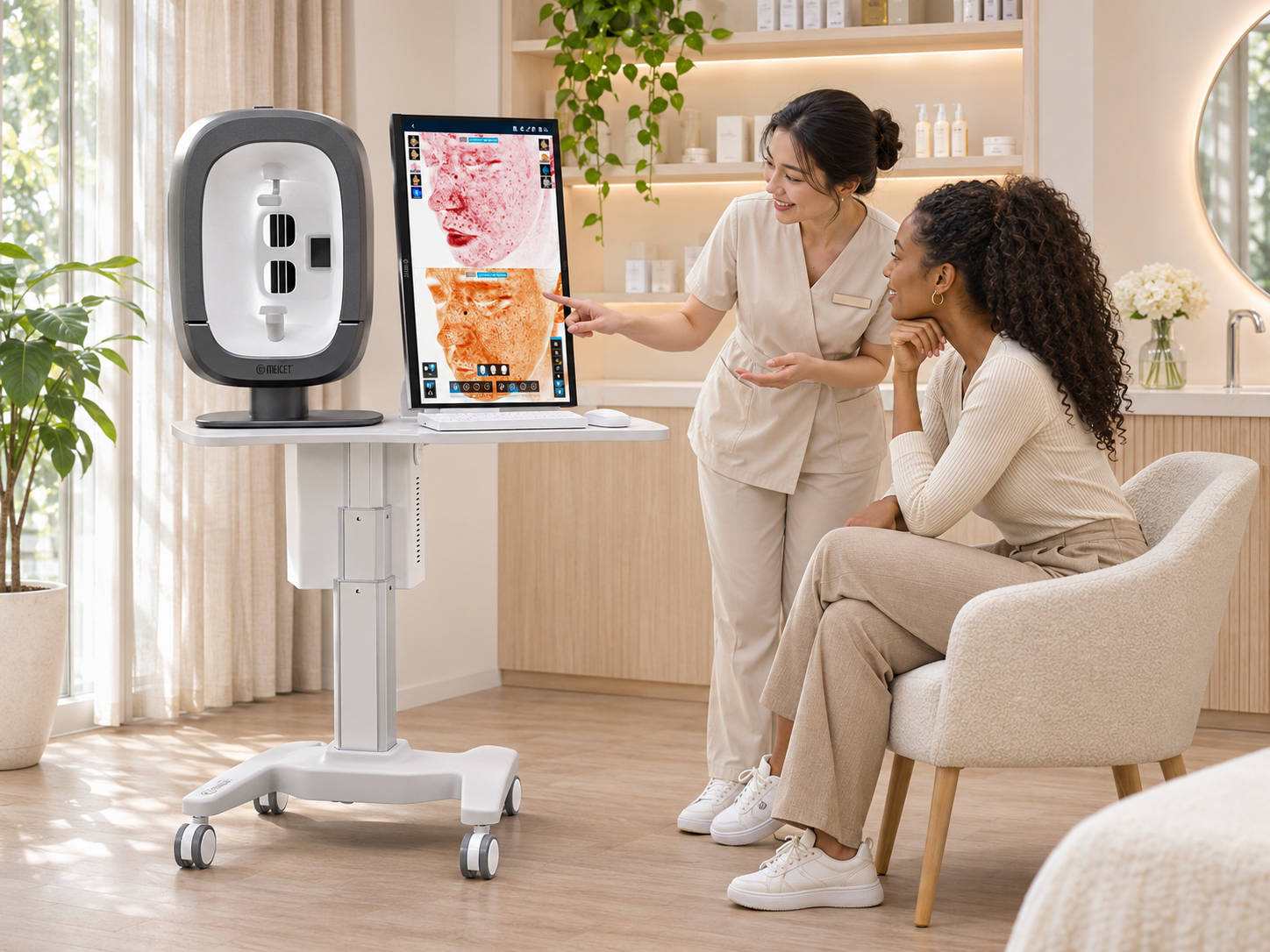
A professional face analysis machine captures standardized facial images under controlled lighting conditions and applies algorithms to quantify visible skin features—but it does not diagnose medical conditions or prescribe treatments. The device’s output is a visual report: scores, counts, area measurements, and side-by-side comparisons of pigmentation, redness, pores, texture, and fine lines.
The distinction matters for investment evaluation. If a business owner expects the machine to “find” problems that automatically convert into treatment sales, disappointment is likely. The conversion happens when a trained staff member walks the client through the report.
The Real ROI Mechanism: Where the Money Comes From
The financial return on a face analysis machine comes from three levers: conversion rate, average transaction value, and visit frequency. None of these levers operate automatically.
| ROI Lever | What the Machine Provides | What the Business Must Supply | Typical Time to Impact |
|---|---|---|---|
| Conversion rate | Visual evidence of skin concerns | Staff trained to interpret and connect findings | Immediate |
| Average transaction value | Multi-zone findings justifying plans | Service menu structured around packages | 2–4 weeks |
| Retention rate | Dated image comparison across visits | Follow-up scheduling protocol | 1–3 months |
What Separates a Useful Device from an Expensive Mirror
Spectral Range
UV imaging reveals sun damage; cross-polarized imaging shows deeper vascular patterns. Without these, you only see what’s in a normal mirror.
Repeatability
Consistent positioning and lighting are essential. If images aren’t comparable across visits, progress tracking fails.
Data Integration
The device must fit your workflow. Manual exports create friction that causes staff to stop using the machine.
The Hidden Costs No One Mentions
| Cost Category | Typical Nature | Operational Implication |
|---|---|---|
| Staff training | Ongoing, not one-time | Budget for quarterly refresher sessions |
| Consultation time | +10–15 minutes | Adjust booking templates |
| Device maintenance | Cleaning/Updates | Assign a staff member as device owner |
Practical Evaluation Framework
Identify the specific client conversation that currently fails.
Operate the device in your space for at least one full week.
Walk 3-5 real clients through a mock report without selling.
Determine break-even volume based on total cost of ownership.
Checklist: Evaluation Criteria
- [ ] Captures UV and cross-polarized images.
- [ ] Repeatable head placement guides.
- [ ] Interface allows for annotations.
- [ ] Side-by-side comparison in < 1 minute.
Frequently Asked Questions
Q: How long does it typically take for a face analysis machine to pay for itself?
A: For a business with 20–30 new clients per month, the payback period is commonly several months to a year.
Q: Do I need a medical-grade device or is a salon-grade machine sufficient?
A: A salon-grade device with multi-spectral imaging is sufficient for consultation purposes in non-medical clinics.
Q: Will clients feel uncomfortable or “analyzed” by the machine?
A: It depends on framing. Introduce it as a “skin check-in” or “progress photo” to help tailor recommendations.
Post time: Nov-24-2026


