


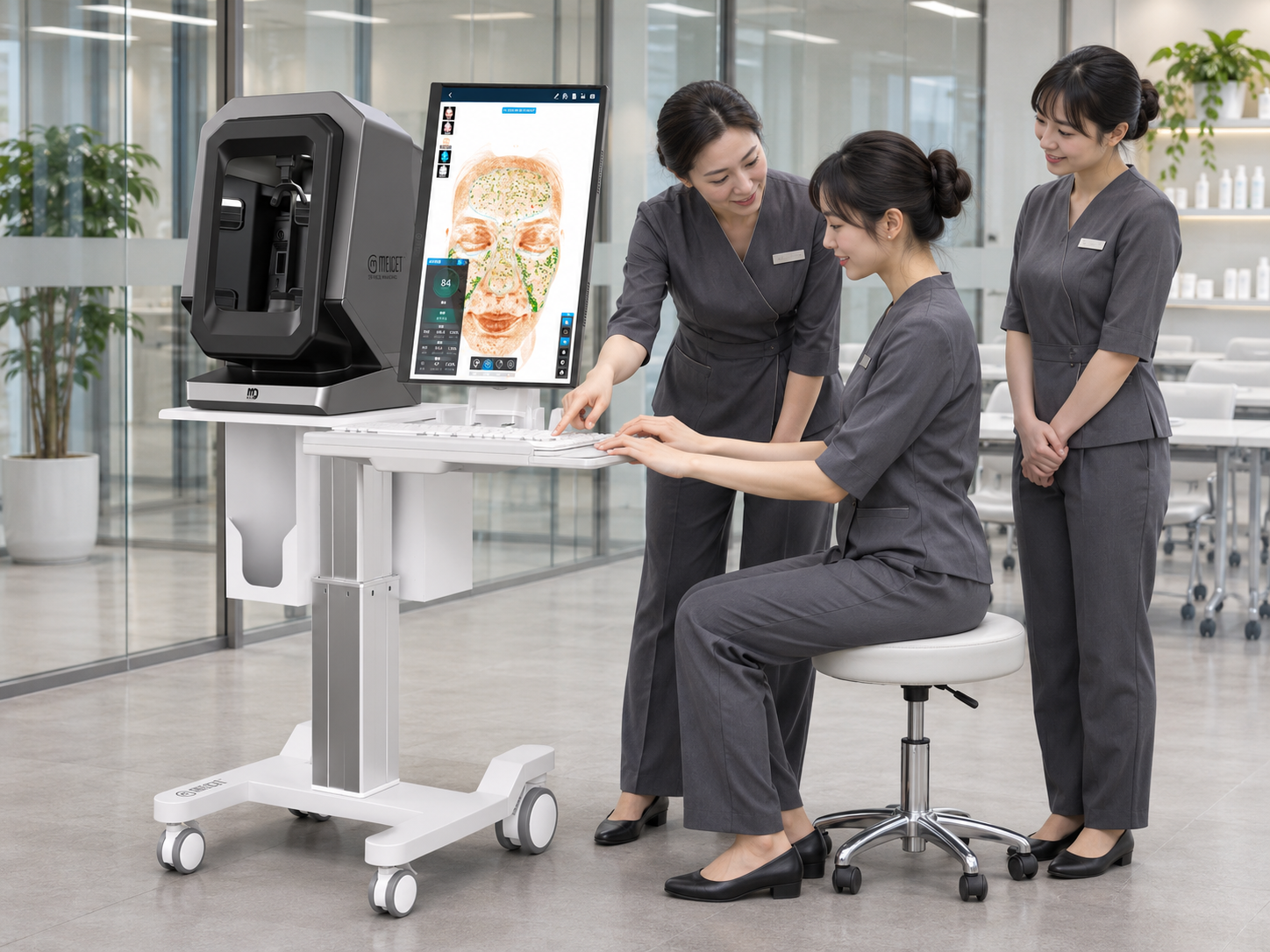
Quick Answer: A professional skin detector machine should be disinfected between every client using a two-step process: first clean the contact surfaces to remove visible debris and oils, then apply an EPA-registered (or local equivalent) low-level disinfectant wipe or spray and allow it to remain visibly wet for the full contact time stated on the product label. The critical contact points are the chin rest, forehead support, and any manual control buttons the client or staff touches during positioning. High-touch non-contact surfaces such as the device housing and positioning handles should also be wiped between clients. Alcohol prep pads can work for small metal components that dry quickly, but pre-saturated disinfectant wipes are generally preferred for larger plastic surfaces because they maintain wet contact time more reliably.
Key Takeaways
- • Skin detector machines are classified as non-critical devices because they contact only intact skin; cleaning followed by low-level disinfection is the appropriate standard between clients.
- • Cleaning must precede disinfection; disinfectant cannot penetrate sebum, skincare product residue, or positioning gel to reach microorganisms.
- • The chin rest and forehead support are the highest-priority contact surfaces and must be disinfected after every client, as specified by comparable facial imaging device manufacturers.
- • Disinfectant contact time is not optional; the surface must remain visibly wet for the full duration stated on the product label, whether that is 1 minute or 10 minutes.
- • A written log recording date, device, disinfectant product, contact time, and staff initials provides defensible evidence of compliance and supports client trust.
Why Skin Detector Machines Are Classified as Non-Critical Devices
A skin detector machine falls into the non-critical device category because it contacts only intact skin, not mucous membranes or broken tissue. This classification determines the minimum decontamination standard: cleaning followed by low-level disinfection. It does not require sterilization or high-level disinfection, which are reserved for instruments that penetrate skin or contact mucous membranes.
The practical implication for clinic owners is that the disinfection protocol can be simple, fast, and compatible with daily workflow. A device requiring sterilization between clients would be operationally impractical for a consultation tool. The non-critical classification makes the machine safe to use in a high-throughput environment provided the basic two-step process is followed consistently.
The classification also means that the device does not need to be removed from the consultation room or subjected to terminal cleaning procedures designed for surgical suites. The disinfection routine is a surface wipe-down, not a facility-wide process.
The Two-Step Process: Clean First, Then Disinfect
Cleaning and disinfection are distinct steps, and skipping the cleaning step renders the disinfection unreliable. Cleaning removes visible debris—sebum, skincare product residue, makeup particles, and positioning gel—that can shield microorganisms from the disinfectant. Disinfection then kills or inactivates the remaining pathogens on the cleaned surface.
| Step | Purpose | What to Use | Common Mistake |
|---|---|---|---|
| 1. Clean | Remove visible organic matter and residue | Detergent wipe or mild soap solution on lint-free cloth | Skipping this step and applying disinfectant directly to soiled surface |
| 2. Disinfect | Kill or inactivate microorganisms on the cleaned surface | EPA-registered (or local equivalent) low-level disinfectant wipe or spray | Drying the surface before the label contact time has elapsed |
| 3. Document | Provide evidence of compliance | Log entry: date, device, product, contact time, initials | No record kept; unable to demonstrate routine during audit or client inquiry |
Which Surfaces Require Disinfection Between Every Client
The chin rest and forehead support are the non-negotiable contact surfaces that require disinfection after every client. Comparable facial imaging devices explicitly instruct users to disinfect the chin and forehead rests after every examination, and a skin detector machine with similar positioning supports follows the same logic.
The chin rest and forehead support contact the client’s skin directly and accumulate sebum, sweat, and skincare residue during positioning. These surfaces are the primary vector for potential cross-contamination between clients. They must be cleaned and disinfected after every use without exception.
Manual control buttons and positioning handles are secondary contact surfaces. If the client or staff member touches a button or handle during the positioning process, that surface should be included in the between-client wipe-down. The same applies to any surface the client’s hands rest on during the scan.
Choosing the Right Disinfectant for Your Device
The correct disinfectant is the one that meets three criteria: it is registered for low-level disinfection of non-critical surfaces in your jurisdiction, it is compatible with the device’s materials, and it can be applied within your clinic’s workflow without disrupting client throughput.
| Disinfectant Format | Best Use Case | Advantages | Limitations |
|---|---|---|---|
| Pre-saturated wipes | Chin rest, forehead support, housing | Consistent dose, easy to use, disposable | Some products may leave residue; cost per wipe higher |
| Spray and cloth | Larger housing surfaces | Cost-effective for high volume | Risk of over-spray; cloth must be laundered |
| 70% Isopropyl Alcohol | Small metal components, buttons | Fast-drying, widely available | Evaporates quickly; poor for large surfaces |
For clinics evaluating a specific system’s material compatibility and cleaning requirements, the ISEMECO 3D D9MAX product page provides a reference for the device’s construction and positioning support design.
Training Staff and Documenting Compliance
Disinfection protocols fail not because the products are unavailable but because staff are not trained, not supervised, and not accountable. A written protocol and a simple log transform disinfection from an informal habit into a verifiable operational standard.
The log is the simplest accountability mechanism. A one-line entry per client—date, device, disinfectant product name, contact time observed, and staff initials—creates a contemporaneous record that the protocol was followed. The log should be stored with the device or in a location accessible to all staff.
Frequently Asked Questions
Q: How often does a skin detector machine need to be disinfected?
A: The chin rest and forehead support must be cleaned and disinfected after every client. The device housing and non-contact surfaces should be disinfected at the start and end of each day, or more often if visibly soiled.
Q: Can I use alcohol wipes to disinfect the machine?
A: 70% isopropyl alcohol pads can work for small metal components or buttons that dry quickly, but alcohol evaporates too fast to maintain contact time on larger plastic surfaces like the chin rest and forehead support.
Q: Do I need to clean the machine before disinfecting it?
A: Yes. Disinfectants cannot penetrate sebum, skincare residue, or positioning gel to reach microorganisms. Cleaning removes these barriers, and disinfection is only effective on a visibly clean surface.
Q: Is UV light acceptable for disinfecting the machine between clients?
A: No. At least one state regulatory body explicitly states that UV light is not acceptable for disinfection in salon settings. UV cabinets are not a substitute for chemical disinfection.
Post time: Nov-24-2026


